 Add to Chrome
 Add to Firefox
 Add to Edge
Limits of Resolution Equivariance in Fourier Neural Operators
May 30, 2026
Fourier Neural Operators are often assumed to generalize across spatial resolutions, enabling training on a coarse grid and deployment on a finer grid. We test this assumption by contrasting two inference-time choices when moving from training resolution $s$ to test resolution $S>s$: running FNO directly at $S$, or running at $s$ and upsampling the prediction to $S$ via Fourier zero-padding. On Darcy flow, we observe that direct fine-grid inference is not reliably beneficial and can be worse than the low-grid-plus-upsampling baseline. We further analyze layerwise spectra and find that, under Fourier truncation, intermediate representations increasingly concentrate energy in low frequencies, with high-frequency output produced mainly by late nonlinear/decoder stages. This offers a mechanistic explanation for why FNO can perform well while retaining few modes, yet remain sensitive under resolution shifts. Our findings highlight a simple but strong baseline for cross-resolution evaluation and point to nonlinear aliasing as a key obstacle to zero-shot resolution equivariance.

Trading Complexity for Expressivity Through Structured Generalized Linear Token Mixing
May 29, 2026Token mixing layers play a key role in how language models can learn and generate long-range dependencies. Their efficiency relies on the necessary trade-off between decoding speed and the memory requirements, along with the cache size. Considering causal generation, this paper explores new trade-offs thanks to a unified framework which separates two crucial features: (i) the direct influence of inputs on outputs in one generation step; (ii) the recurrent propagation of information through past outputs. This framework encompasses major architectures such as attention and state-space models, but also generalizes the recurrence equations by allowing each state to depend on multiple past states rather than only the immediate predecessor. By introducing structure, we design new recurrence patterns that provably achieve the desired complexity, while providing theoretical insights on their expressivity -- trading runtime for expressivity in a principled way. Empirical validation is performed on synthetic tasks, along with language modeling. Together, these results provide a unified toolkit for the understanding and design of efficient and expressive token mixers across model families.
Structured-Sparse Attention for Entity Tracking with Subquadratic Sequence Complexity
May 21, 2026Entity tracking requires maintaining and updating latent states for entities and attributes over long sequences. Recent task-specific attention operators can compress deep Transformer stacks into a few layers by performing multi-hop state propagation within a single layer, but their dense evaluation remains expensive. We show that in this setting, learned attention is strongly structured: most mass concentrates in local block-diagonal neighborhoods with a light cross-block residue. Exploiting this, we derive a blockwise evaluation of a resolvent-style operator that keeps within-block interactions exact and routes cross-block interactions through a reduced system. The resulting evaluation is subquadratic in sequence length $O(n^{4/3}d)$ (and $O(n^{7/3})$ when $d\approx n$). On controlled tracking benchmarks, our method matches the dense operator's accuracy while reducing wall-clock time by $12-29\%$ under a standardized measurement protocol, and is up to $2.4 \times$ faster than a compact dense Transformer at comparable exact-match accuracy. We further provide ablations over block size and model capacity, and identify a limitation: performance collapses when the number of simultaneously evolving properties exceeds the number of attention heads.
Responsible Benchmarking of Fairness for Automatic Speech Recognition
May 11, 2026Many studies have shown automatic speech processing (ASR) systems have unequal performance across speakergroups (SG's). However, the manner in which such studies arrive at this conclusion is inconsistent. To pave the wayfor more reliable results in future studies, we lay out best practices for benchmarking ASR fairness based on literaturefrom machine learning fairness, social sciences, and speech science. We first describe the importance of preciselythe fairness hypothesis being interrogated, and tailoring fairness metrics to apply specifically to said hypothesis.We then examine several benchmarks used to rate ASR systems on fairness and discuss how their results can bemisconstrued without assiduous oversight into the intersections between SG's. We find that evaluating fairnessbased on single heterogeneous SG's, such as they are defined in fairness benchmarks, can lead to misidentifyingwhich SG's are actually being mistreated by ASR systems. We advocate for as fine-grained an analysis as possibleof the intersectionality of as many demographic variables as are available in the metadata of fairness corpora in orderto tease out such spurious correlations
Identifying and typifying demographic unfairness in phoneme-level embeddings of self-supervised speech recognition models
Apr 24, 2026Modern automatic speech recognition (ASR) systems have been observed to function better for certain speaker groups (SGs) than others, despite recent gains in overall performance. One potential impediment to progress towards fairer ASR is a more nuanced understanding of the types of modeling errors that speech encoder models make, and in particular the difference between the structure of embeddings for high-performance and low-performance SGs. This paper proposes a framework typifying two types of error that can occur in modeling phonemes in ASR systems: random error/high variance in phoneme embedding, vs systematic error/embedding bias. We find that training phoneme classification probes only on a single, typically disadvantaged SG, sometimes improves performance for that SG, which is evidence for the existence of SG-level bias in phoneme embeddings. On the other hand, we find that speakers and SGs with higher levels of phoneme variance are the same as those with worse phoneme prediction accuracy. We conclude that both types of error are present in phoneme embeddings and both are candidate causes for SG-level unfairness in ASR, though random error is likely a greater hindrance to fairness than systematic error. Furthermore, we find that finetuning encoder models using a fairness-enhancing algorithm (domain enhancing and adversarial training) changes neither the benefits of in-domain phoneme classification probe training, nor measured levels of random embedding error.
Where Do Self-Supervised Speech Models Become Unfair?
Apr 20, 2026Speech encoder models are known to model members of some speaker groups (SGs) better than others. However, there has been little work in establishing why this occurs on a technological level. To our knowledge, we present the first layerwise fairness analysis of pretrained self-supervised speech encoder models (S3Ms), probing each embedding layer for speaker identification (SID) automatic speech recognition (ASR). We find S3Ms produce embeddings biased against certain SGs for both tasks, starting at the very first latent layers. Furthermore, we find opposite patterns of layerwise bias for SID vs ASR for all models in our study: SID bias is minimized in layers that minimize overall SID error; on the other hand, ASR bias is maximized in layers that minimize overall ASR error. The inverse bias/error relationship for ASR is unaffected when probing S3Ms that are finetuned for ASR, suggesting SG-level bias is established during pretraining and is difficult to remove.
Polynomial Mixing for Efficient Self-supervised Speech Encoders
Feb 28, 2026State-of-the-art speech-to-text models typically employ Transformer-based encoders that model token dependencies via self-attention mechanisms. However, the quadratic complexity of self-attention in both memory and computation imposes significant constraints on scalability. In this work, we propose a novel token-mixing mechanism, the Polynomial Mixer (PoM), as a drop-in replacement for multi-head self-attention. PoM computes a polynomial representation of the input with linear complexity with respect to the input sequence length. We integrate PoM into a self-supervised speech representation learning framework based on BEST-RQ and evaluate its performance on downstream speech recognition tasks. Experimental results demonstrate that PoM achieves a competitive word error rate compared to full self-attention and other linear-complexity alternatives, offering an improved trade-off between performance and efficiency in time and memory.
Forward Only Learning for Orthogonal Neural Networks of any Depth
Dec 19, 2025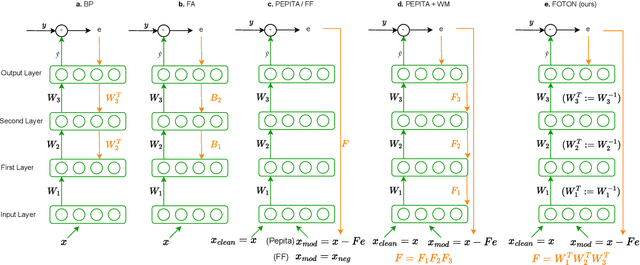
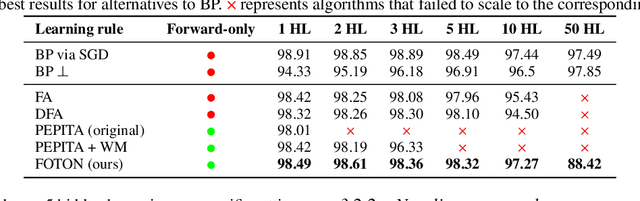

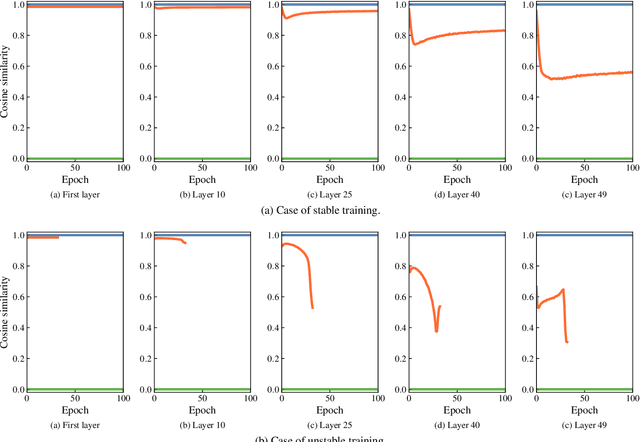
Backpropagation is still the de facto algorithm used today to train neural networks. With the exponential growth of recent architectures, the computational cost of this algorithm also becomes a burden. The recent PEPITA and forward-only frameworks have proposed promising alternatives, but they failed to scale up to a handful of hidden layers, yet limiting their use. In this paper, we first analyze theoretically the main limitations of these approaches. It allows us the design of a forward-only algorithm, which is equivalent to backpropagation under the linear and orthogonal assumptions. By relaxing the linear assumption, we then introduce FOTON (Forward-Only Training of Orthogonal Networks) that bridges the gap with the backpropagation algorithm. Experimental results show that it outperforms PEPITA, enabling us to train neural networks of any depth, without the need for a backward pass. Moreover its performance on convolutional networks clearly opens up avenues for its application to more advanced architectures. The code is open-sourced at https://github.com/p0lcAi/FOTON .
On the MIA Vulnerability Gap Between Private GANs and Diffusion Models
Sep 03, 2025Generative Adversarial Networks (GANs) and diffusion models have emerged as leading approaches for high-quality image synthesis. While both can be trained under differential privacy (DP) to protect sensitive data, their sensitivity to membership inference attacks (MIAs), a key threat to data confidentiality, remains poorly understood. In this work, we present the first unified theoretical and empirical analysis of the privacy risks faced by differentially private generative models. We begin by showing, through a stability-based analysis, that GANs exhibit fundamentally lower sensitivity to data perturbations than diffusion models, suggesting a structural advantage in resisting MIAs. We then validate this insight with a comprehensive empirical study using a standardized MIA pipeline to evaluate privacy leakage across datasets and privacy budgets. Our results consistently reveal a marked privacy robustness gap in favor of GANs, even in strong DP regimes, highlighting that model type alone can critically shape privacy leakage.
Linear Attention with Global Context: A Multipole Attention Mechanism for Vision and Physics
Jul 03, 2025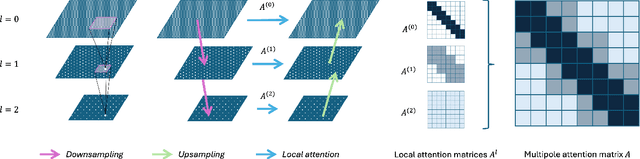


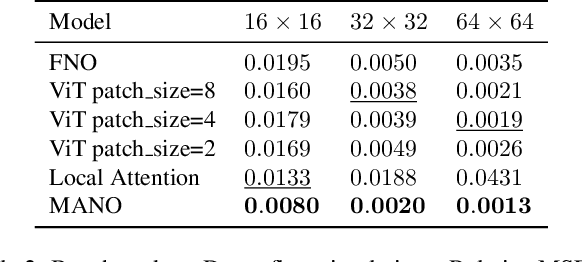
Transformers have become the de facto standard for a wide range of tasks, from image classification to physics simulations. Despite their impressive performance, the quadratic complexity of standard Transformers in both memory and time with respect to the input length makes them impractical for processing high-resolution inputs. Therefore, several variants have been proposed, the most successful relying on patchification, downsampling, or coarsening techniques, often at the cost of losing the finest-scale details. In this work, we take a different approach. Inspired by state-of-the-art techniques in $n$-body numerical simulations, we cast attention as an interaction problem between grid points. We introduce the Multipole Attention Neural Operator (MANO), which computes attention in a distance-based multiscale fashion. MANO maintains, in each attention head, a global receptive field and achieves linear time and memory complexity with respect to the number of grid points. Empirical results on image classification and Darcy flows demonstrate that MANO rivals state-of-the-art models such as ViT and Swin Transformer, while reducing runtime and peak memory usage by orders of magnitude. We open source our code for reproducibility at https://github.com/AlexColagrande/MANO.